


Picking a haircut can feel hard when barbers use so many fade names. Two of the most common are the temple fade and the taper fade. They look close, but they are not the same. In the temple fade vs taper fade debate, placement is the key. A temple fade cleans the temples and sideburns. A taper fade blends the hair around the ears and neckline.
This guide explains each cut in simple words. You will learn the guard numbers, the best hairstyles, and how to ask your barber. You will also see how each fade grows out and how much upkeep it needs. It covers Black hair, curly hair, and straight hair. Read on to find the fade that fits your hair, your style, and your daily routine.
Temple Fade vs Taper Fade: Key Differences
Here is the short version. Both cuts blend short hair into longer hair. Both look clean. The difference is placement.
Quick answer: A temple fade blends hair around the temples and sideburns. A taper fade blends hair around the ears and the back of the neck. The temple fade is sharper at the front. The taper fade is softer all around.
Here is a side by side look.
| Feature | Temple Fade | Taper Fade |
| Where it starts | Temples and sideburns | Ears and neckline |
| Main look | Sharp and defined | Soft and gradual |
| Contrast | Medium to high | Low to medium |
| Sides and back | Often left longer | Blended all the way around |
| Upkeep | Every 2 to 3 weeks | Every 3 to 4 weeks |
| Best mood | Bold and clean | Classic and neat |
Think of it this way. A temple fade is like a frame around your face. A taper fade is like a soft shadow around your head.
What Is a Temple Fade?

A temple fade is a haircut that fades the hair at the temples. It also covers the sideburn area. Some people call it a temp fade. Others call it a Brooklyn fade.
The fade often starts near the front of the head. It then blends back toward the ear. Many barbers also add a crisp line at the front. This gives you a clean temple line and a sharp hairline.
The sides and back may stay a bit longer. That is why it feels different from a full skin fade. The cut draws the eye to your face. It makes your forehead and cheekbones look cleaner.
Here are the main traits of a temple fade:
- The fade is focused on the temples and sideburns.
- The hairline is sharp and defined.
- The look is bold but not extreme.
- It pairs well with a line up.
A temple fade haircut works on many hair types. It looks great with waves, curls, and short crops. It also works for men who want a strong frame without a very short cut on the sides.
What Is a Taper Fade?
A taper fade is a haircut where the hair gets shorter in small steps. The change happens around the ears and the neckline. The top of the sides stays longer. The edges get tight.
Many pros treat the taper as a soft kind of fade. That is why the name taper fade is so common. The blend is gentle. It does not jump from long to bare skin in one move.
You see a taper fade in offices, schools, and weddings. It looks neat in a suit. It also looks fresh with a messy top.
Here are the main traits of a taper fade:
- The blend sits around the ears and the back of the neck.
- The change in length is slow and smooth.
- It keeps more length on the sides than a skin fade.
- It is easy to style and easy to wear.
There are three common heights. A low taper fade starts near the ears. A mid taper fade starts around the middle of the sides. A high taper fade starts up near the temples.
Read More: Hispanic Mexican Low Taper Fade: 12 Best Styles
Mid Temp Fade vs Mid Taper Fade
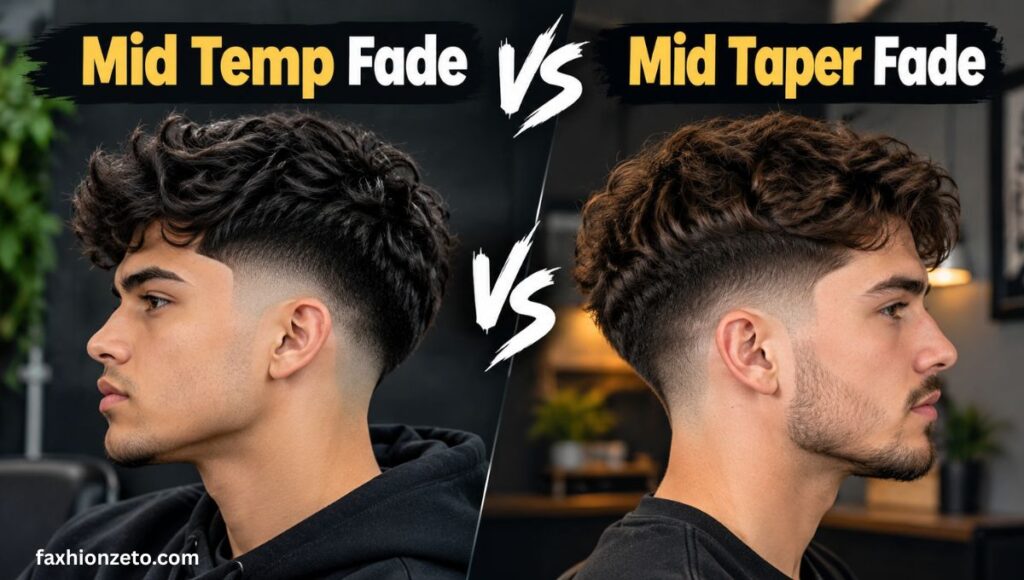
Both of these cuts can start at the same spot. The middle of the sides is a common start line. That is why people mix them up.
The difference is the shape of the blend.
A mid temp fade pushes the shortest hair toward the front. The temple area gets very clean. The fade then curves toward the ear. The result is a sharp front edge.
A mid taper fade keeps the blend more even. The hair gets shorter around the whole head. It wraps from the sideburn to the back of the neck.
Mid temp fade meaning: The fade starts mid-height and focuses on the temple.
Mid taper fade meaning: The fade starts mid-height and blends evenly around the head.
If you like a strong face frame, pick the mid temp fade. If you like one smooth shape from front to back, pick the mid taper fade.
Temple Fade vs Taper Fade for Black Hair

Black hair has its own needs. It is often dense and coily. It holds a shape well. That is why both fades look so sharp on it.
A temple fade is popular here. The defined line shows up clearly on coily hair. It looks great with waves and short twists. It also looks great with a high top.
A taper fade is just as popular. The soft blend suits natural curls and fro styles. It keeps the sides tidy without removing too much length.
Here are a few tips for Black hair:
- Ask for a barber who knows your texture.
- Use a light moisturizer on the top. Dry hair breaks.
- Care for the skin on the edges. Bumps can form from close cuts.
- Wear a soft cap or scarf at night to protect your shape.
Both cuts can work well. The best choice depends on your head shape and your style.
Temple Fade vs Taper Fade for Black Men

Many Black men like a crisp hairline. A temple fade delivers that. The line is clear and strong. It looks fresh for work, parties, and photos.
A taper fade offers a calmer look. It works well when you want a clean cut that does not draw too much attention. It also grows out in a softer way.
Here is a simple way to choose:
- Want a bold, sharp frame? Choose the temple fade.
- Want a clean and calm shape? Choose the taper fade.
- Want both? Ask for a temple taper (more on that soon).
Talk to your barber about your hairline. A strong hairline looks great with a temple fade. A thinner hairline may look better with a soft taper.
Low Taper Fade vs Temp Fade

This one is easy to mix up. A low taper fade is subtle. The fade sits low on the head. It hugs the ears and the neckline. The temples are barely touched.
A temp fade works the other way. The temples get the most attention. The ears and neckline may stay longer.
Low taper fade: Subtle, low, and clean around the ears and neck.
Temp fade: Sharper, focused on the temple and sideburn.
If you want a cut that nobody can quite name, go with the low taper. It just looks neat. If you want a cut that people notice, go with the temp fade.
Low Temple Fade Explained
A low temple fade keeps the fade small. It touches only the lower part of the temple and the sideburn. The rest of the sides stay a bit fuller.
This cut is a great start for first timers. It is not too short. It is easy to grow out. It also gives you a clean edge around the face.
Here is what a low temple fade does:
- It cleans the sideburns.
- It trims the lower temple area.
- It leaves more hair above the fade.
- It looks sharp without looking harsh.
If you are nervous about a big change, start low. You can always go higher next time.
Temple Taper Fade: What Does It Mean?
A temple taper fade mixes both ideas. The temples get a clean, defined fade. The ears and neckline get a soft taper.
Some barbers use the term for a taper that starts at the temple. That is a high taper. Others use it for a blend of both styles. Because the name is not fixed, always show a photo.
You get the best of both worlds. The front looks sharp. The back looks smooth. It is a great pick when you cannot decide.
Which Fade Should You Get?
The right pick depends on your hair, your style, and your daily life. Ask yourself three questions.
- How bold do I want to look?
- How often can I visit the barber?
- What does my hair do when it grows?
Let’s turn those answers into a plan.
Get a Temple Fade If
- You want a sharp frame around your face.
- You like a crisp hairline and clean sideburns.
- You are fine with a trim every two to three weeks.
- You want a cut that pairs well with a beard line up.
- You have a strong hairline.
Get a Taper Fade If
- You want a soft, classic look.
- You work in an office or a school.
- You want a cut that grows out slowly.
- You like a smooth blend with no hard lines.
- You want a cut that suits many hair types.
Can’t Decide? Try a Combination
Ask for a taper at the neckline. Then ask for a clean temple fade at the front. This gives you a smooth back and a sharp face. It is also an easy way to test both looks.
You can also try one first. Wear it for a month. Then change it up if you want.
Temple Fade and Taper Fade Guard Numbers

Guard numbers tell you how much hair stays. A lower number means shorter hair. A higher number means longer hair. Clippers differ by brand, so ask your barber to confirm.
Here is a simple guide. Many barbers use a range like this:
| Guard | Rough Length | Typical Use |
| Bare or skin | 0 mm | Shortest point in a skin fade |
| #0 | About 0.5 mm | Very close edge |
| #1 | About 3 mm | Short and clean |
| #2 | About 6 mm | Short with a little shadow |
| #3 | About 10 mm | Medium blend |
| #4 | About 13 mm | Longer blend |
Temple fade and taper fade guard numbers:
- Temple fade: Often starts with a #0 or #1 at the temple and sideburn. It then blends up to a #2 or #3.
- Taper fade: Often starts with a #1 or #2 at the neckline. It then blends up to a #3 or #4.
What guard number is a temple fade? There is no single number. Most use a #1 or #2 at the shortest point.
You may hear people say “#2 to #1 to skin.” That means the barber starts at a #2. Then the blend moves to a #1. Then it ends at bare skin. A #1 into skin fade is a bit shorter and sharper. Fade from #2 to skin is a bit softer.
The haircut guard numbers you choose depend on the look. Skin gives a crisp, high contrast look. A #2 gives a warm, soft look.
Best Hairstyles for Each Fade

The top matters as much as the sides. A good pairing makes the whole cut look planned.
Temple Fade Pairings
- Edgar cut: A blunt fringe over a sharp temple line. It looks strong.
- Curly top: Curls look fuller next to a clean temple.
- Afro: A shaped fro with a sharp temple line looks bold.
- Blowout: Big, soft volume on top with crisp sides.
- Waves: Brush waves look best with a defined hairline.
Taper Fade Pairings
- Textured crop: Messy on top and tidy on the sides.
- Side part: A classic look for work.
- French crop: Short and neat with a straight fringe.
- Slick back: A smooth top with a soft taper.
- Quiff: Raised hair in front with a clean blend.
- Curly top: Soft curls with a gentle edge.
Some tops work with both. A textured top, a short crop, and a quiff all look great with either cut. The sides set the mood.
How to Ask Your Barber for the Right Fade
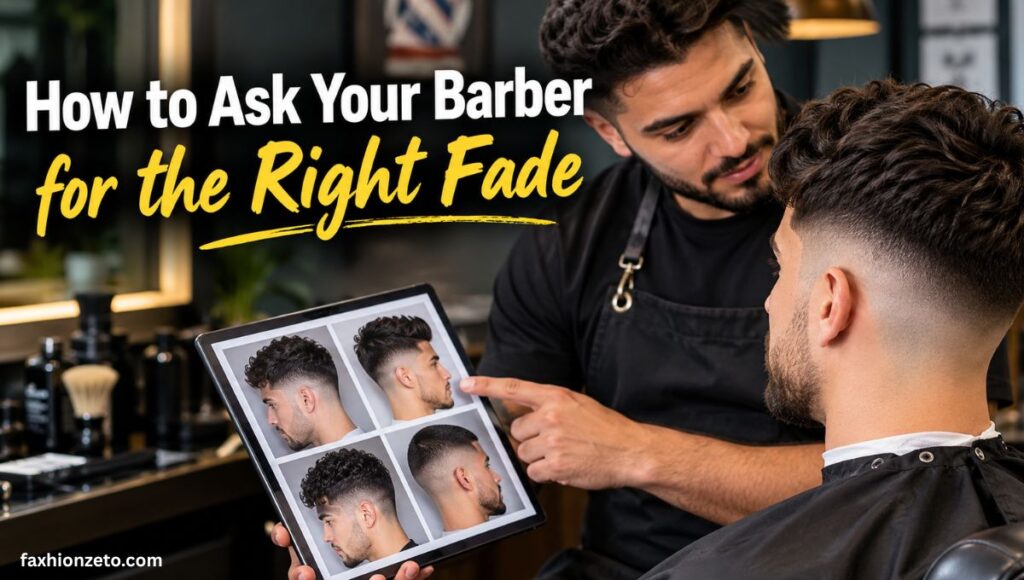
Barbers are skilled. Still, they cannot read your mind. A clear request saves you from a bad cut.
Here is a simple script:
- Name the cut. “I want a temple fade,” or “I want a taper fade.”
- Pick the height. “Low,” “mid,” or “high.”
- Pick the finish. “Down to skin,” or “Leave a shadow.”
- Give guard numbers. “Start at a #1 and blend up to a #3.”
- Explain the top. “Keep the length on top. Just clean it up.”
- Talk about the line. “Give me a clean temple line,” or “No hard line, please.”
Bring a photo. A picture shows the exact look. It also avoids mix ups with names. Pick a photo with a head shape and hair type like yours.
Try this short script: “Can I get a mid taper fade? Start at a #1 at the neckline and blend up to a #3. Keep the top long. Soft edges, please.”
If you want a temple fade, try: “Can I get a low temple fade with a clean line up? Start at a #1 and blend into a #2.”
Temple Fade vs Taper Fade: Maintenance and Grow-Out
Every fade needs upkeep. The sharper the cut, the faster it fades out.
Temple Fade Maintenance
A temple fade shows growth fast. The temple line gets fuzzy in about two weeks. Plan a visit every two to three weeks. A quick line up between visits can help.
Here is what you can do at home:
- Wash and moisturize as usual.
- Use a soft brush to keep your hair neat.
- Do not shave the line yourself. It is easy to go too far.
Taper Fade Maintenance
A taper fade is more forgiving. It grows out in a soft way. You can often wait three to four weeks. The shape stays neat for longer.
A taper fade touch up is a simple trim at the neckline and ears. Many barbers do it fast.
Grow-Out Stages
Here is what to expect as your hair grows.
| Time | Temple Fade | Taper Fade |
| Week 1 | Sharp and fresh | Clean and smooth |
| Week 2 | Line gets soft | Still neat |
| Week 3 | Looks fuzzy at the temple | Blend starts to widen |
| Week 4 | Needs a trim | Looks full, time for a trim |
A haircut touch up schedule helps you stay on track. Mark it on your calendar. Pick the same day each cycle.
Which one is more low maintenance? The taper fade wins here. The temple fade needs more care. The payoff is a sharper look.
Frequently Asked Questions
Is a Temp Fade the Same as a Temple Fade?
Yes. Temp fade is a short name for temple fade. Both mean the same cut.
Is a Temple Fade the Same as a Taper Fade?
No. A temple fade focuses on the temples and sideburns. A taper fade blends around the ears and neckline.
Can You Combine a Temple Fade With a Taper Fade?
Yes. Ask for a clean temple fade at the front and a taper at the neckline. Many barbers call it a temple taper.
Which Lasts Longer, a Temple Fade or a Taper Fade?
A taper fade lasts longer. It grows out softly and looks neat for three to four weeks.
What Looks Better, a Taper or a Fade?
It depends on your style. A taper looks soft and classic. A fade looks bolder and sharper.
What Fade Is Most Attractive?
There is no single answer. The best fade matches your face shape, hair type, and style. A clean, well-blended cut always looks good.
What Guard Number Is a Temple Fade?
Most barbers start with a #0 or #1 at the temple. They then blend up to a #2 or #3.
Is a Temple Fade Professional Enough for Work?
Yes, in most offices. Keep the line soft and the top neat. A low temple fade is the safest pick.
Does a Temple Fade Work With Straight Hair?
Yes. It gives straight hair a crisp edge and a neat frame. Ask for a soft blend so it does not look too harsh.
Conclusion
The temple fade vs taper fade choice is simple once you know the placement. A temple fade is sharp and bold at the front. A taper fade is soft and classic around the ears and neckline.
Pick the temple fade for a strong frame. Pick the taper fade for an easy, neat look. Or ask for both. Bring a photo, share your guard numbers, and plan your trims. With a good barber, you will leave with a cut that fits you.

Isaac Flynn is a fashion writer and content researcher at Faxhionzeto.com. He focuses on fashion trends, styling ideas, clothing guides, and modern wardrobe inspiration. With an interest in visual culture and fashion journalism, Isaac creates practical, reader focused articles that turn evolving style ideas into clear, useful information for everyday fashion enthusiasts.